
What a Court Docket Records in Lauderdale County
A docket is a list. It shows each step a case takes, in the order those steps happen. Court staff add a new line every time something is filed or decided. A single entry usually names the date, the type of event, the party involved, and a short note on what the judge or clerk did. Read top to bottom, the docket tells the story of a case without the full paperwork behind it.
The docket is not the case file. The file holds the actual documents: the complaint, the motions, the exhibits, the signed orders. The docket is the index that points to all of it. A line might read that a motion was filed or that a hearing was set, but the motion itself lives in the file. That difference matters when you need proof for a legal purpose, because a printout of the docket is not the same as a certified copy of an order.
Dockets in Lauderdale County vary by court level. Circuit Court dockets track felony cases, jury trials, and large civil suits. Chancery Court dockets follow divorce, estate, guardianship, and land matters. County and Justice Court dockets carry smaller civil claims, misdemeanors, traffic, and the early steps of criminal cases. Each court labels its entries a little differently, but the purpose is the same everywhere: a clear, dated trail of what has happened and what comes next.
Finding Lauderdale County Court Dockets
Mississippi Electronic Courts, known as MEC, is the statewide e-court system for participating Circuit, County, and Chancery Courts. It is the most likely online path for civil and criminal case dockets, though access may require registration and the clerk can confirm what is posted. The Mississippi Judiciary hosts the system, and the MEC help desk answers at helpdesk@mec.ms.gov or 601-576-4650. When a docket is not online, the clerk who manages that court can pull it for you.
Where you look depends on the court. A clear way to reach a docket is to follow these steps in order.
- Identify the court that holds the case. Match the case type to Circuit, Chancery, County, Justice, or Municipal Court before searching.
- Check MEC for Circuit, County, and Chancery dockets, keeping in mind that some documents stay restricted or need a login.
- Contact the clerk for that court if the docket is not online or you need a certified entry. The Circuit Clerk covers Circuit and County Court files, and the Chancery Clerk covers Chancery cases.
- Call the right office for lower courts. Justice Court hearing dates run through Court Administrator Nikita Wilkins, and Meridian Municipal traffic dockets route through the city Courts and Records line.
- Review the docket entries, then request a certified copy of any order you need for legal use.
The Circuit Clerk, Renee Covert, manages Circuit and County Court records and can be reached at 601.482.9731 or circuitclerk@lauderdalecounty.org. Her office sits at the courthouse complex and takes mail at PO Box 1005, Meridian, MS 39302-1005.
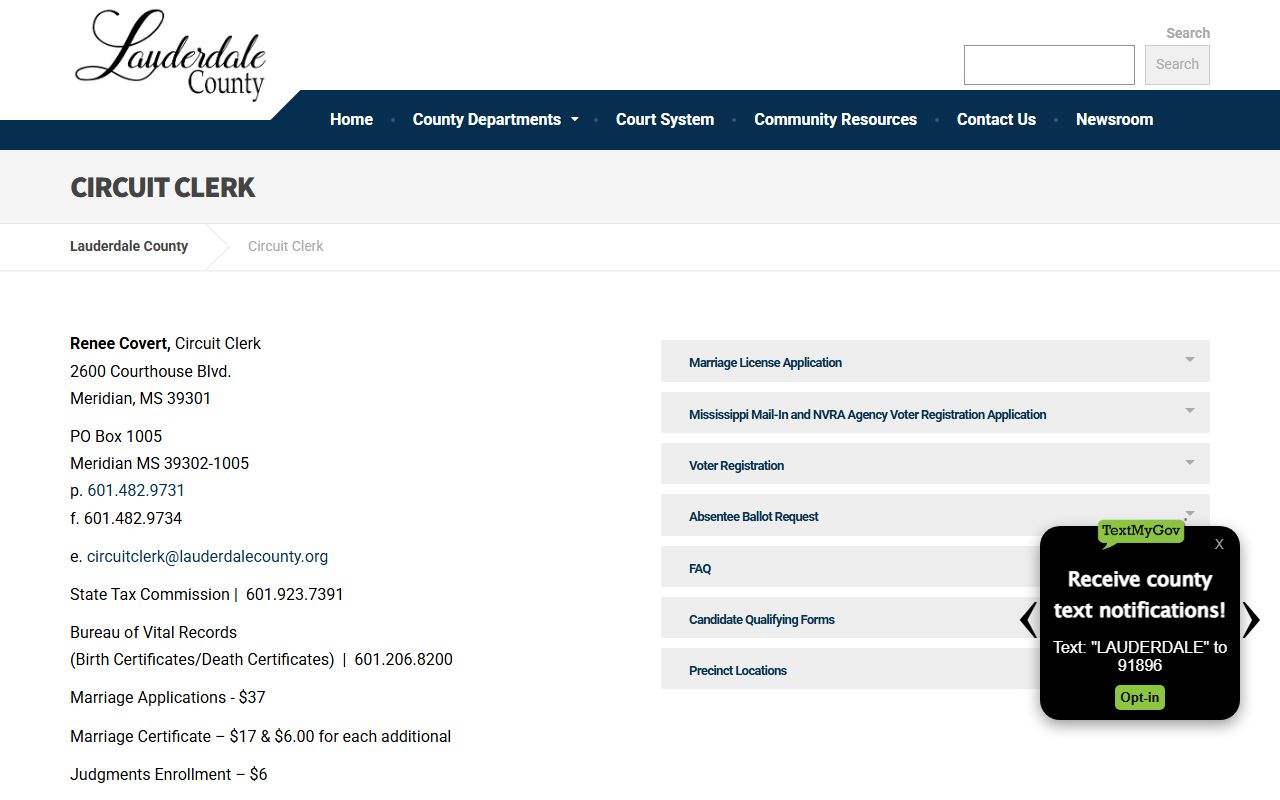
The Circuit Clerk page is the starting point for Circuit and County Court docket questions, including jury matters, judgments, and case files that predate the online system. For older retired files, the county also routes some records to its archives on Constitution Avenue.
Sample Lauderdale County Docket Entries
Every docket line follows a pattern. It ties an event to a date, names the parties, and notes the result. The sample below shows the kinds of entries that appear across Lauderdale County cases, drawn from the common event types courts log. Case numbers and names here are illustrative, but the columns mirror what a real docket shows.
| Case Number | Filing Date | Parties | Event / Entry Type | Hearing Date | Disposition |
|---|---|---|---|---|---|
| CI-2025-0142 | Jan 14, 2025 | Smith v. Davis | Complaint filed; summons issued | Pending | Open |
| CI-2025-0142 | Feb 03, 2025 | Smith v. Davis | Motion filed | Mar 11, 2025 | Hearing set |
| CR-2025-0078 | Feb 20, 2025 | State v. Johnson | Indictment; arraignment | Apr 02, 2025 | Plea entered |
| CR-2025-0078 | Apr 02, 2025 | State v. Johnson | Bond hearing | Apr 02, 2025 | Bond set |
| CH-2025-0331 | Mar 05, 2025 | In re Estate of Lee | Order entered | May 19, 2025 | Continuance |
| CR-2025-0078 | Jun 16, 2025 | State v. Johnson | Judgment; sentencing | Jun 16, 2025 | Disposed |
The same case number repeats as a case grows, with one new line per event. Reading the rows in date order shows how a matter moves from filing to a hearing, then to a judgment or other final result. A blank or pending hearing date means no future court date is set yet.
Courts That Publish Lauderdale County Dockets
Lauderdale County runs several trial courts, and each keeps a different kind of docket. The county is part of the 10th Judicial District, with Circuit Court judges Charles W. Wright Jr. and Robert T. "Bo" Bailey. Knowing which court hears your case type points you to the docket that has it.
- Circuit Court: felony criminal cases, jury trials, large civil suits, and appeals from lower courts. Dockets run through MEC and the Circuit Clerk.
- Chancery Court: divorce, child custody and support, estates, guardianships, and land disputes. The Chancery Clerk manages these case dockets.
- County Court: shared civil and criminal matters up to $200,000, transferred felony cases, and appeals from Justice and Municipal Court.
- Justice Court: small claims up to $3,500, county misdemeanors, traffic, DUI, bond hearings, and arrest warrants. Hearing dates come from the Court Administrator.
- Meridian Municipal Court: city traffic and ordinance cases, with payment and case questions through the city Courts and Records office.
Chancery Court is separate because Mississippi keeps an equity court for family, property, and probate matters. The Chancery Court docket is managed by Chancery Clerk Carolyn Mooney, who can be reached at 601.482.9701 or chanceryclerk@lauderdalecounty.org for case filings, hearings, and recorded land instruments.
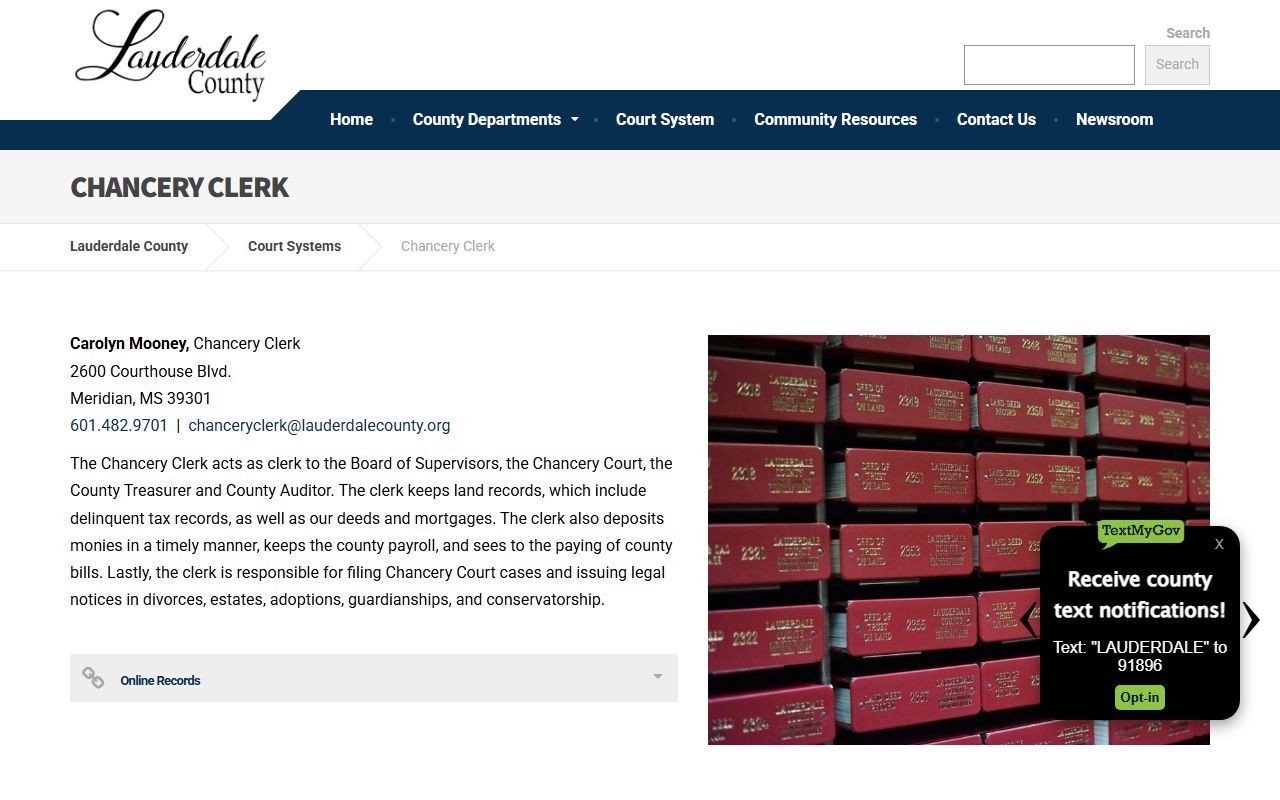
The Chancery Court page is where divorce, estate, and guardianship docket questions begin, and the same office handles land records and recorded documents. Justice Court matters, by contrast, route through Court Administrator Nikita Wilkins at 601.482.9879 for hearing dates and case status.
Lauderdale County Dockets vs Full Case Records
People often want the docket when they really need the full file, or the other way around. The docket is a quick map of a case. The full record is the box of documents behind it. Each serves a clear purpose, and the right choice depends on what you plan to do with it.
| Docket | Full Case Record | |
|---|---|---|
| Format | Dated list of events | Filed documents and orders |
| Access | Often online through MEC | Clerk copy, certified for legal use |
| Cost | Free or low cost to view | Copy and certification fees apply |
| Use | Track progress and hearing dates | Legal proof, evidence, appeals |
To view how a case is moving, the docket is enough. To file something with another court or prove an outcome, you need a certified copy from the clerk. Public copies cost $0.25 per page, staff copies cost $0.50 per page, and certification adds a fee. A broader look at how case files work is covered on the Lauderdale County court records page.
Hearing Dates and Continuances on the Docket
Hearing dates are some of the most-checked lines on any docket. When a judge sets a date, the clerk adds an entry that names the type of hearing and when it will be held. That single line tells parties, attorneys, and the public when to show up. Missing it can carry real cost, since a missed criminal court date can lead to a bench warrant.
Dates change often. A continuance is a postponement, and it shows on the docket as a new entry that moves the hearing to a later day. Continuances happen for many reasons, from scheduling conflicts to new motions. The old date stays in the record, and the new one is added below it. Reading the most recent entry is the only safe way to know the current date.
Justice Court hearing dates are not always posted online. The county FAQ directs people to the Justice Court for the correct hearing date and the amount owed on a citation. For municipal traffic matters in Meridian, the city Courts and Records office answers at 601.485.1836. Calling the right office beats relying on a printout that may already be out of date.
Note: Always confirm a hearing date with the clerk or court administrator before relying on it, because continuances can move a date after the docket was last printed.
Federal Court Dockets for Lauderdale County
Some cases tied to Lauderdale County are not in county court at all. Federal criminal, civil, and bankruptcy matters route to the U.S. District Court for the Southern District of Mississippi. Lauderdale sits in the Northern Division, with filings handled in Jackson. Federal dockets are kept in a separate system from the state and county courts, so a county search will never show them.
Bankruptcy cases have their own court. The U.S. Bankruptcy Court for the Southern District of Mississippi hosts a Case Locator, electronic filing, and a court calendar for the district. Its calendar and case tools point users to the federal docket for any bankruptcy filed in the area.
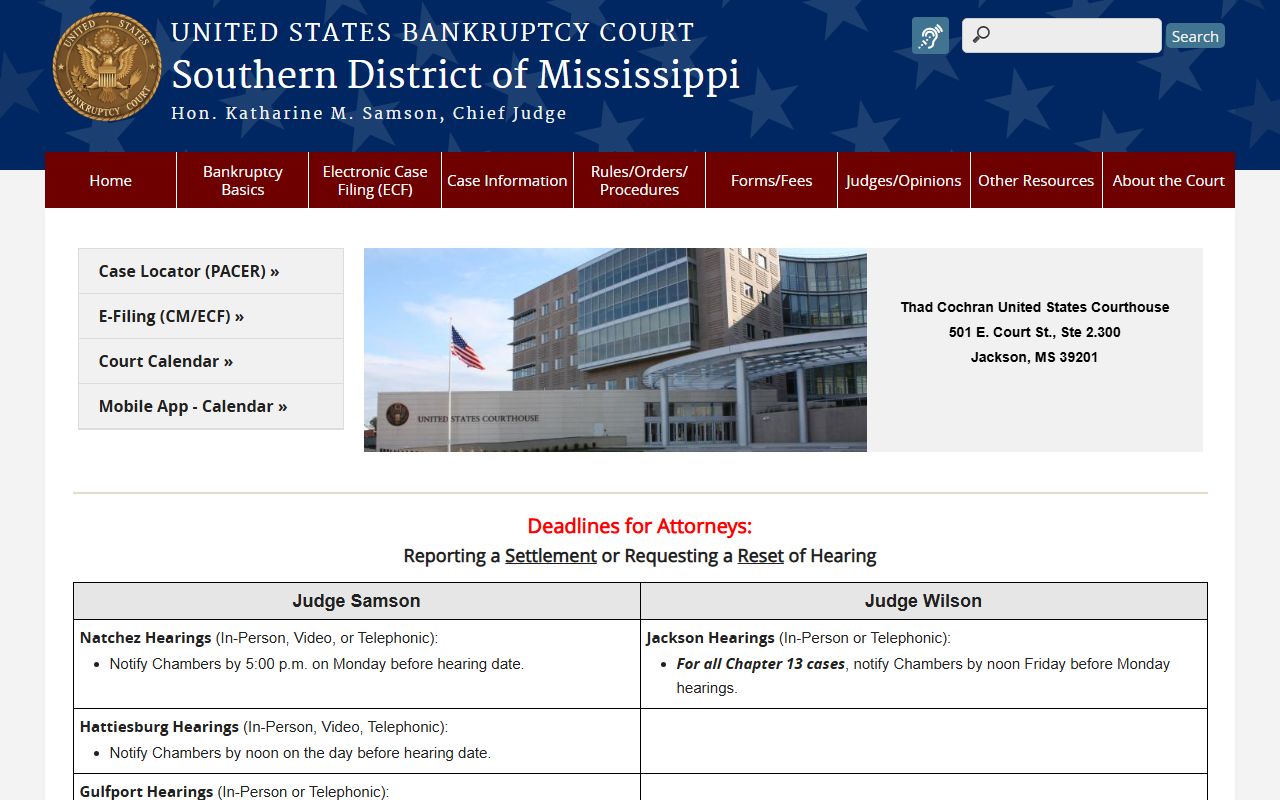
The bankruptcy court page links the case locator and calendar that surface federal dockets for the district. For district court cases and most federal records, the central system is PACER, which indexes dockets across every federal court.
PACER, short for Public Access to Court Electronic Records, is the federal docket system. The Court CM/ECF Lookup tool helps you find the right court by type and circuit before you search a docket. PACER requires an account, and fees apply to most searches and document downloads.
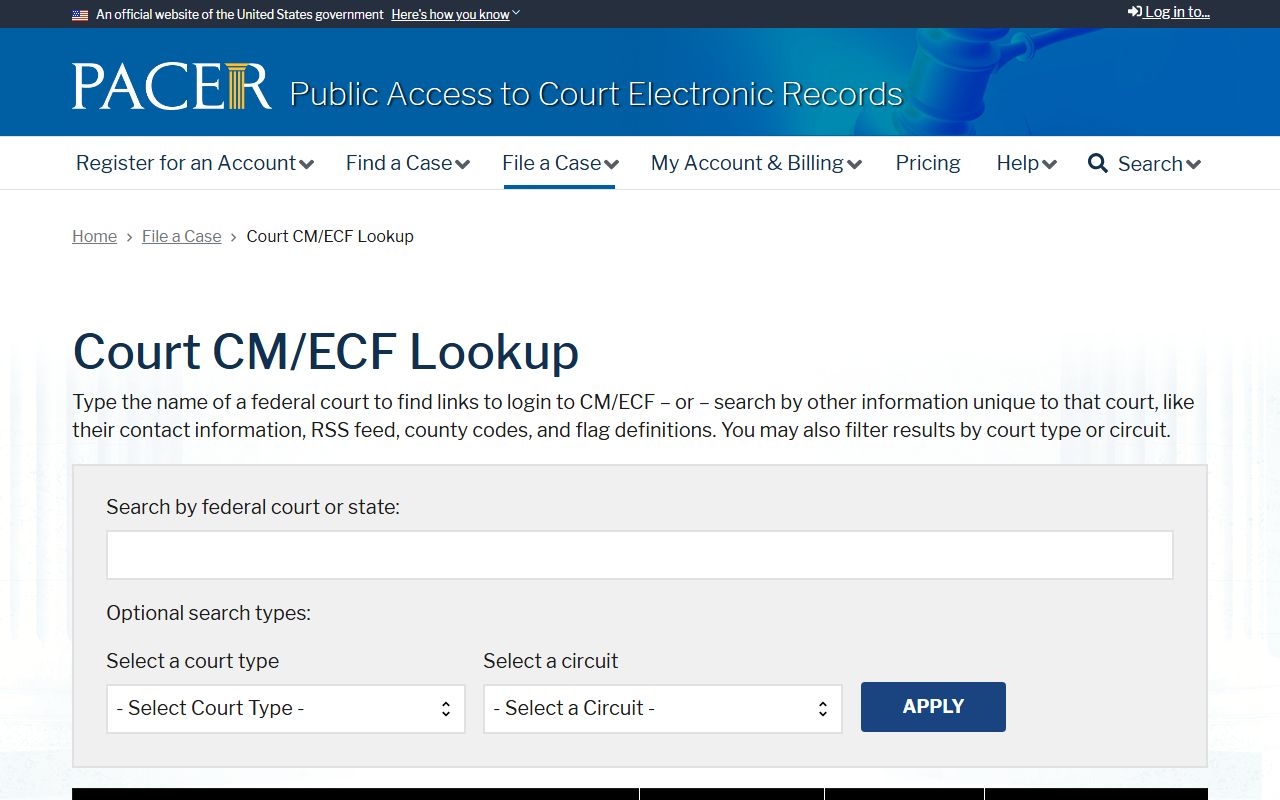
The CM/ECF lookup connects to the docket for each federal court that touches Lauderdale County matters. Certified federal records still come from the court itself, so PACER is the index while the clerk supplies official copies.
Reading a Lauderdale County Docket
Docket entries use short, legal terms that can be hard to follow at first. Each one stands for a specific step in a case. Learning a few common terms makes the whole record readable, since the same words appear across Circuit, Chancery, County, and Justice Court dockets.
- Disposition
- The outcome of a charge or case, such as guilty, dismissed, or judgment entered.
- Continuance
- A postponement that moves a hearing or trial to a later date.
- Arraignment
- The hearing where charges are read and the defendant enters a plea.
- Motion
- A written request asking the judge to take a specific action.
- Order
- A judge's written ruling on a motion or other matter.
- Judgment
- The final decision that resolves the rights, money, or guilt at issue.
Status words also appear on the docket. A case may read as open, disposed, transferred, dismissed, or sealed. A transfer entry means the case moved to another court, such as a felony sent from County Court to Circuit Court. A dismissed entry may note whether it was with or without prejudice, which decides if the matter can be refiled.
Appeals show on the docket too. When a party appeals a lower court ruling, an entry marks the notice of appeal and the case heads up the ladder, often from Justice or Municipal Court to County Court, and from Circuit Court toward the Mississippi Court of Appeals. A missing record does not always mean no case existed, since a file may be sealed, expunged, or filed under a different court level. When a docket is unclear, the clerk for that court can confirm the current status.