
Criminal Court Records in Lauderdale County
A criminal court record is the case file the clerk builds once charges are filed against a defendant. It is more than a single charge. It is a running log of every event in the case, from the charging document through the final order. The clerk's office keeps the master file, dockets each entry by date, and stores the orders a judge signs. Once a case opens, the record grows with each motion, hearing, plea, and ruling. For a closer look at the charges that start a case, the arrest and court charge records trace the path from booking to the prosecutor's filing.
Several courts handle criminal matters in Lauderdale County, and the level depends on the offense. Circuit Court is the felony trial court for the 10th Judicial District, which also covers Clarke, Wayne, and Kemper counties. County Court hears non-capital felony cases transferred from Circuit Court and handles appeals from lower courts. Justice Court takes county misdemeanors, traffic, and DUI cases, and it holds the first hearings in many felony cases, including initial appearances, bond hearings, and preliminary hearings. Meridian Municipal Court covers city ordinance and misdemeanor matters. Each court keeps its own criminal file.
How to Search Lauderdale County Criminal Court Records
Mississippi Electronic Courts, known as MEC, is the statewide system for participating Circuit, County, and Chancery courts. It is the most likely online path to a Circuit or County Court criminal case file, though access may require registration and the clerk can confirm what is available. When the case is not online, the Circuit Clerk and County Court Clerk hold the paper and certified copies. Start by deciding which court level handled the case, then work the right channel.
- Confirm the court level first. Felony cases sit in Circuit or County Court, while misdemeanors and DUIs sit in Justice or Municipal Court.
- Open MEC for Circuit and County Court cases, or contact the clerk directly when no online file appears.
- Search by the defendant's name or the case number, which is the fastest match.
- Narrow the results by court, case type, and filing date to reach the right file.
- Open the case to read the docket, the charges, and the final disposition.
- Request a certified copy from the clerk of record when a sealed or court-ready document is needed.
Statewide criminal history is a separate track. A name-based check shows charges across courts, but only an official record from the court of conviction reflects the true outcome. Justice Court is often the front door for warrant, bond, and early charge questions, since many felonies pass through it before a grand jury acts.
Stages of a Criminal Case
A criminal case moves through set stages, and each stage leaves its own mark in the record. The earliest entries cover the charge and the first appearance. Later entries cover pleas, motions, and the trial or plea deal. The last entries cover the verdict, the disposition, and the sentence. Reading the docket in order shows exactly where a case stands and how it closed.
Case flow: Charges Filed › Arraignment › Pretrial / Motions › Plea or Trial › Disposition › Sentencing
| Stage | What Happens |
|---|---|
| Charges Filed | The prosecutor files a charge, or a grand jury returns an indictment, and the clerk opens the case file. |
| Arraignment | The court reads the charges, the defendant enters a plea, and the judge sets bond and conditions. |
| Pretrial / Motions | Lawyers file motions, exchange evidence, set hearings, and argue points of law before trial. |
| Plea or Trial | The defendant pleads guilty under a deal, or a judge or jury decides guilt at trial. |
| Sentencing | After a guilty plea or verdict, the judge imposes prison, probation, fines, restitution, or a mix. |
Note: A Lauderdale County grand jury that met in 2026 examined twelve witnesses and returned indictments in ninety-five cases over two days, with six cases not indicted.
What a Lauderdale County Criminal Court Record Shows
A criminal case file packs many fields into one record. Some come from the charge, some from the court, and some from the final order. The roster a jail keeps shows only the booking charge, while the court file shows the prosecutor's decision, the plea, and the outcome. Reading every field together gives the full picture of a case.
| Field | What It Shows |
|---|---|
| Case Number | The unique court file number, used to pull the record and any certified copies. |
| Court and Division | Whether the case sits in Circuit, County, Justice, or Municipal Court. |
| Defendant | The person charged, listed against the State of Mississippi as the other party. |
| Charges | The offense as filed, the statute cited, and whether it is a felony or a misdemeanor. |
| Docket Entries | Each dated event: motions, hearings, continuances, orders, and the indictment or arraignment. |
| Plea | The defendant's formal answer, such as guilty, not guilty, or no contest. |
| Disposition | The outcome of each charge, such as convicted, dismissed, or acquitted. |
| Sentence | The punishment imposed, including prison, probation, fines, restitution, and court costs. |
Sensitive details inside a file may be redacted. Social Security numbers, dates of birth, and victim or minor information are commonly removed before the public sees a record. A full set of Lauderdale County court records covers the civil and family files that fall outside the criminal division.
The District Attorney and Lauderdale County Cases
The prosecutor drives every felony criminal case file. In Lauderdale County, that role belongs to the District Attorney for the 10th Judicial District. The DA reviews arrests, decides what to charge, presents felony matters to the grand jury, negotiates pleas, and tries cases in Circuit Court. The office also handles victim and witness issues. Many entries in a criminal record trace back to a prosecutor's decision, from the first charge to a plea offer to a dismissal.
The current District Attorney is Kassie Coleman, whose office sits in the courthouse complex on Courthouse Blvd. in Meridian. The Lauderdale County District Attorney page lists the office address, phone, and email for case and charging questions tied to the felony criminal court files in the county.
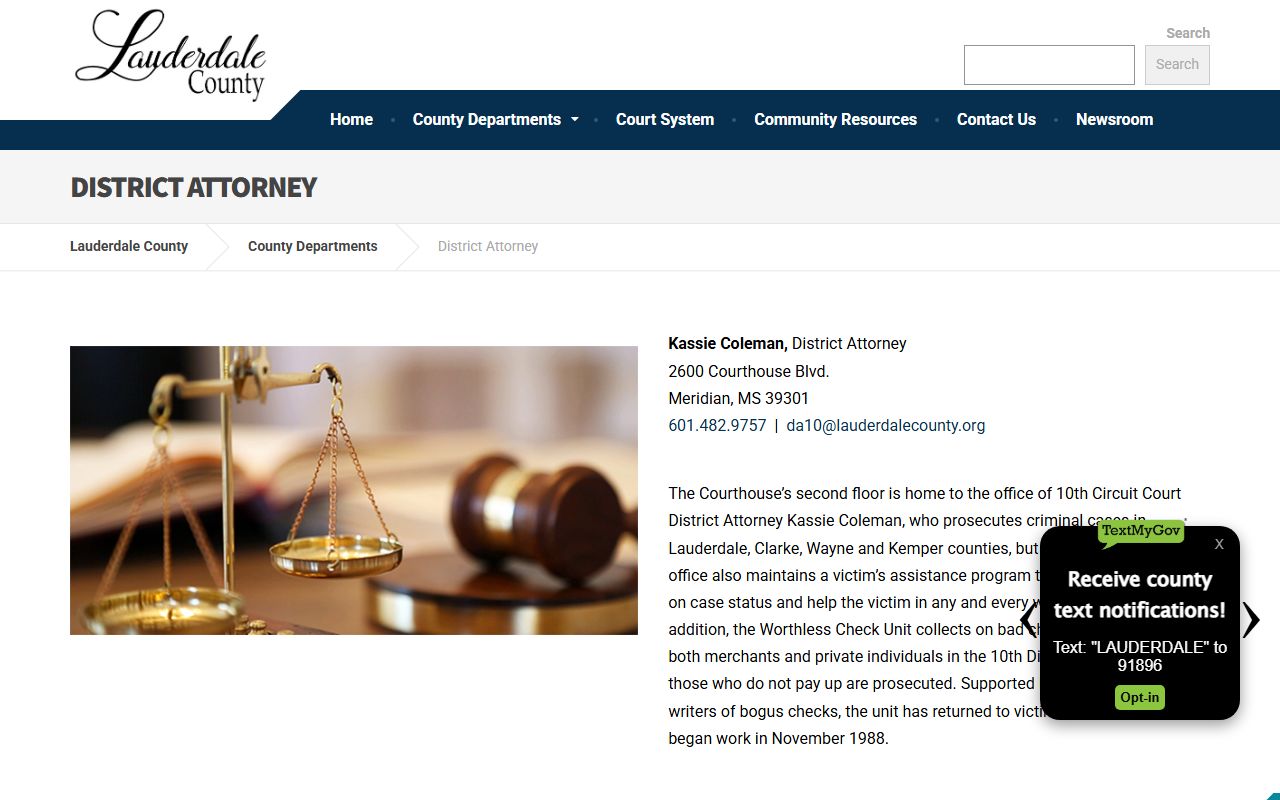
Because the prosecutor controls charging, a sheriff's booking charge can differ from the charge the court files weeks later. The grand jury may return a different count, and the DA may amend, reduce, or drop a charge before trial.
Charges vs. Convictions
Being charged is not the same as being convicted. A charge is an accusation. A conviction is a finding of guilt by plea or verdict. A criminal court record can show charges that were later dropped, dismissed, or that ended in acquittal. The presence of a charge in a file does not prove the person did anything. The disposition is where the truth of the outcome lives.
| Charge | Conviction | |
|---|---|---|
| Stage | Accusation at filing | Verdict or guilty plea |
| Burden of Proof | Probable cause | Beyond a reasonable doubt |
| Decided By | Prosecutor or grand jury | Judge or jury |
| Public Record | Yes | Yes |
This gap matters most for background checks and old cases. A file may list a felony arrest that the court later dismissed, and the record should reflect that result. Always read to the final order before drawing a conclusion about guilt.
Reading Dispositions and Sentences
The disposition is the outcome of a charge, and it is the single most important field in a criminal file. Common entries include guilty, not guilty, dismissed, and nolo contendere, which is a no-contest plea. A judge may also defer judgment so a charge clears after the defendant meets conditions. Each charge in a case can carry its own disposition, so a file with three counts can end three different ways.
The sentence sits right beside the disposition once a defendant is convicted. It can list a prison term, probation, a fine, restitution to a victim, and court costs. A term may run in years or months, and parts of it can be suspended. Probation is a supervised sentence served in the community instead of prison. Reading both the disposition and the sentence together shows what a conviction actually cost.
Sealed vs. Expunged Records
Two court actions can pull a criminal record out of public view. Sealing hides a file from public search while keeping it intact for limited official use. Expungement goes further and treats the record as if it never existed. Mississippi allows expungement of eligible convictions and non-convictions under Miss. Code Ann. Section 99-19-71, with eligibility tied to the offense, the outcome, the timing, and any prior record.
| Sealed | Expunged | |
|---|---|---|
| Visibility | Hidden from public search | Destroyed or treated as never existed |
| Law Enforcement | Limited access remains | Very limited access |
| Eligibility | Set by court order and case type | Offense, outcome, and timing under Section 99-19-71 |
| Filed In | Court that handled the case | Court of conviction or charge |
A missing record does not always mean no case existed. The file may be sealed, expunged, filed under a different court level, or simply outside the date range searched. The person who is the subject of a record, or their attorney, may reach files the general public cannot.
Federal Criminal Cases from Lauderdale County
Some Meridian and Lauderdale County crimes are prosecuted in federal court, not state court. Lauderdale County falls in the U.S. District Court for the Southern District of Mississippi, Northern Division, which files in Jackson. Federal charges are handled by the United States Attorney's Office, a separate prosecutor from the county District Attorney. Drug trafficking, firearms, and large conspiracy cases often move to this level. The U.S. Attorney for the Southern District of Mississippi publishes case outcomes that show how local arrests turn into federal sentences.
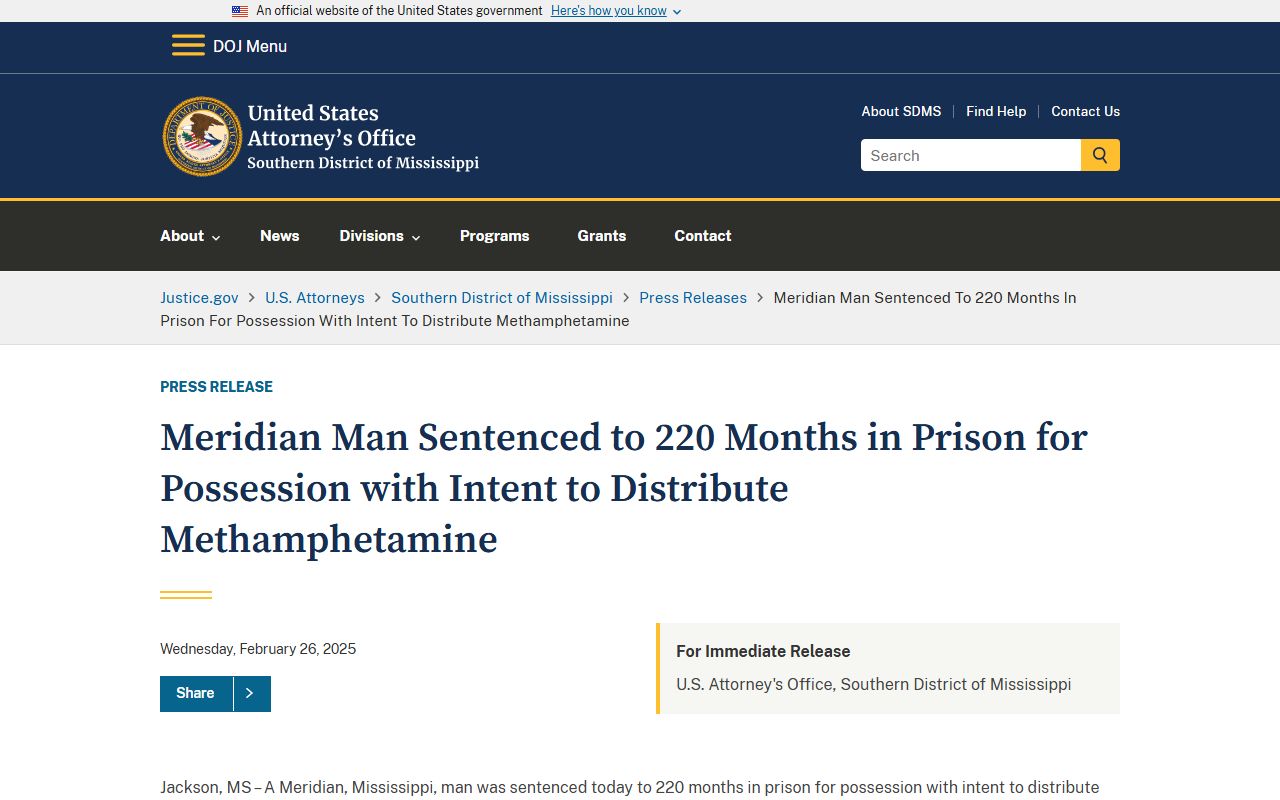
Federal records live in PACER, the federal case system, rather than in the county clerk's office. The cases still tie back to local agencies, since the Lauderdale County Sheriff's Office, the DEA, and the Mississippi Bureau of Narcotics often investigate together. One 2025 case shows the link clearly. A Meridian man sentenced to 220 months for possessing methamphetamine with intent to distribute drew help from local deputies and state agents.
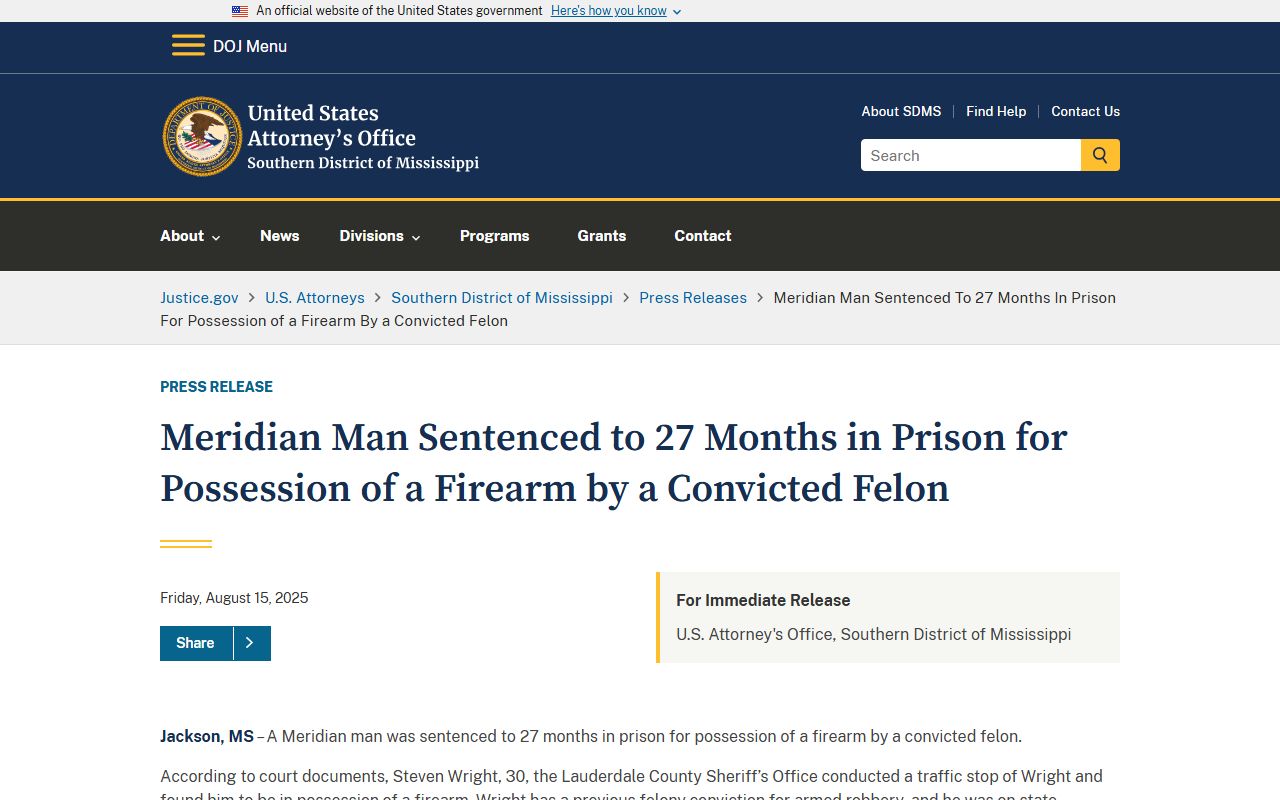
Firearm cases follow the same route when a defendant has a prior felony. A Lauderdale County traffic stop led to one such prosecution, and the Meridian man sentenced to 27 months for possessing a firearm as a convicted felon also had his state supervised release revoked.
Long sentences are common at the federal level. In another 2025 case, a Meridian drug trafficker sentenced to 30 years ran a large area drug-trafficking organization tied to a string of indictments. These outcomes show why a full search may need both the county courts and the federal system.
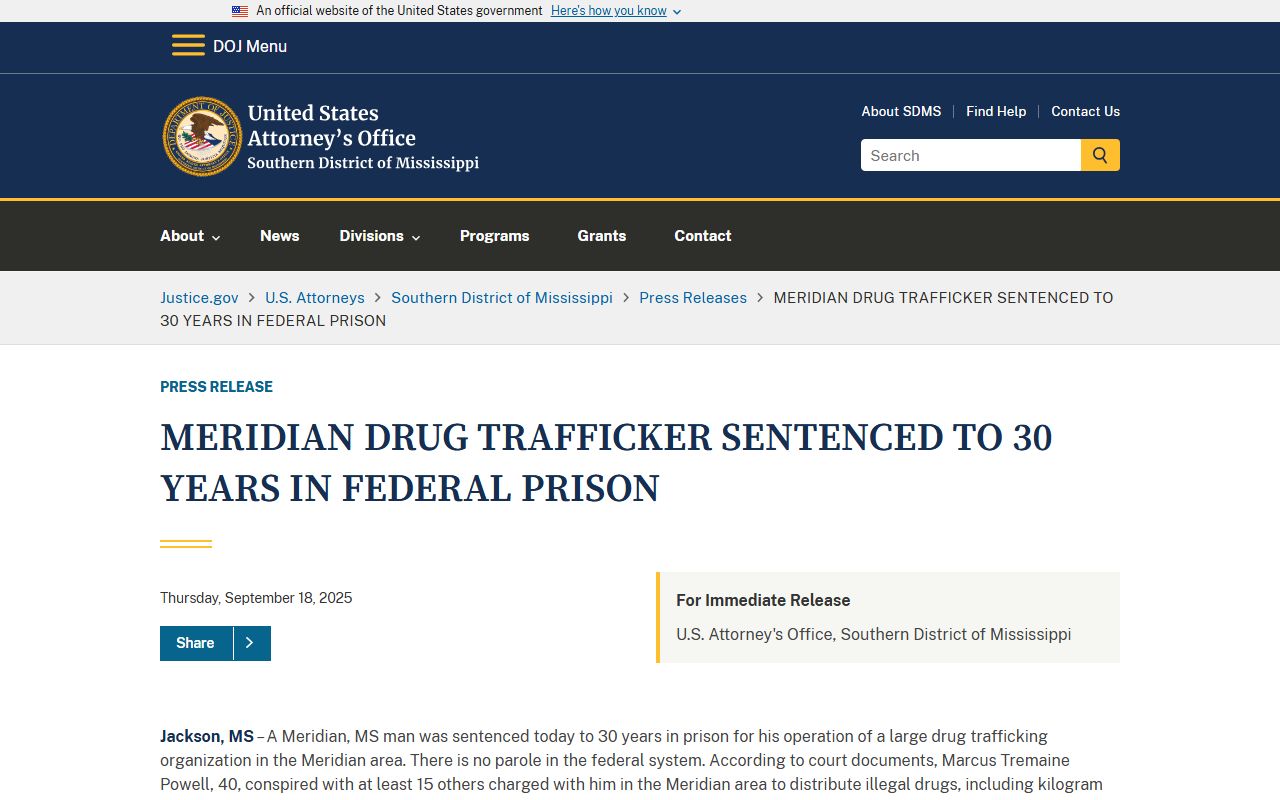
When a person is not in a county case file, the matter may have moved to federal court or to a state prison sentence. Checking the federal docket fills that gap.
Public Access to Lauderdale County Criminal Records
Mississippi treats most court files as open records. The Mississippi Public Records Act presumes that records are available unless another law makes them confidential. A request to the right office, with a description of the document and any required fee, normally clears within a set window. Criminal case files in Circuit, County, Justice, and Municipal Court are public except where a judge seals them or a statute restricts them.
Key Statutes:
Mississippi Code § 25-61-1 - Public records are presumed available unless another law makes them confidential.
Mississippi Code § 25-61-5 - Agencies must provide access under reasonable rules and generally cannot delay beyond seven working days without a written reason.
Mississippi Code § 25-61-7 - Offices may charge a fee set to cover the actual cost of search, review, copying, and mailing.
Note: Copy costs in Lauderdale County run twenty-five cents per page for copies you make and fifty cents per page for staff copies, with certification charged on top.
Background Check Considerations
Open court files are easy to pull, but they are not a formal background check. A casual lookup can miss a sealed case, a charge filed under a slightly different name, or a record held in another court. Employment, tenant, and credit decisions fall under the federal Fair Credit Reporting Act, which sets rules a plain records search does not meet. For those uses, an FCRA-compliant screening service is the correct tool.
Important: This site is not a consumer reporting agency under the FCRA, and its records may not be used for employment, tenant, credit, or insurance screening.
Restricted Lauderdale County Criminal Records
Some criminal records never reach the public file. Youth Court cases involving minors are confidential under Miss. Code Ann. Section 43-21-261, since the court handles delinquency, abuse, and neglect matters for children under eighteen. Sealed and expunged files are also off limits, as are sealed indictments that stay closed until a court unseals them. Law enforcement investigative reports are exempt while a case is active, though incident reports remain public.
Open felony matters can also be thin in public view before a grand jury acts. Charges may shift after a prosecutor's review, an indictment, a plea, or a dismissal, so an early entry is not the last word. For active arrest warrants tied to a case, the Lauderdale County warrant records are tracked through the Sheriff and the courts that issue them. When a record cannot be found at all, the safest read is that it may be restricted, filed elsewhere, or outside the searched dates, not that no case ever existed.